Salt-based softeners and salt-free conditioners get marketed as interchangeable products. They are not. Salt-based softeners remove hardness minerals. Salt-free “softeners” leave them in place but reduce their ability to form scale. Different machines, different results, different buyers.
The chemistry that separates them
Ion exchange (salt-based) swaps calcium and magnesium ions for sodium. Hardness leaves the water, which is why dishes stop spotting, soap lathers properly, and heater elements stop crusting. Template-assisted crystallization (TAC, the standard salt-free media) converts dissolved hardness into microscopic inert crystals that mostly pass through without bonding to surfaces. Scale formation drops; hardness measurement doesn’t change at all.
One consequence follows from that difference and explains most customer disappointment reviews you will read: everything hardness causes by being present stays. Soap still reacts with the minerals. Glassware can still spot as droplets evaporate. The minerals just stop cementing themselves onto heater elements and fixture finishes as effectively. Buyers who wanted slick skin and spot-free dishes bought a scale reducer instead, and the one-star reviews follow.
If you came here from a conditioner ad: those products work, but they do something narrower than the name implies, and the rest of this page is about choosing with that distinction in front of you.
Side by side
| Salt-based softener | Salt-free conditioner | |
|---|---|---|
| Removes hardness | ✓ Yes | ✗ No; conditions only |
| Spot-free dishes, soap lather | ✓ | ✗ |
| Scale on heaters/fixtures | ✓ Prevented | ~ Reduced |
| Adds sodium to water | Trace (~19 mg/8oz glass at 10 gpg) | None |
| Maintenance | Salt refills every 4–8 weeks | Essentially none |
| Drain + power required | Yes | No |
| Standardized certification | NSF/ANSI 44 exists | No equivalent protocol |
| Hardware cost | $450–1,700 | $250–1,500 |
The sodium question
The most common reason buyers hesitate on salt-based systems is a worry about drinking sodium. The quantities are small and easy to compute: ion exchange adds about 7.5 mg of sodium per quart for every grain per gallon of hardness it removes. At 10 gpg that is roughly 19 mg in an eight-ounce glass; at 15 gpg, about 28 mg.
For scale, the FDA’s daily value reference for sodium is 2,300 mg. A glass of softened water contributes around one percent of that; a slice of bread carries about five times more. Households on physician-directed sodium restriction have two clean workarounds anyway: plumb the cold kitchen tap unsoftened (standard practice, cheap to do), or put a reverse osmosis unit under the sink, which strips the added sodium entirely along with everything else it filters.
Potassium chloride regeneration swaps the same chemistry onto potassium instead of sodium at two to three times the salt cost. It works in any metered system and is a legitimate third path for the specific households that need it.
What certification does and does not exist here
Ion exchange has a real standard: NSF/ANSI 44 covers cation-exchange softeners’ capacity claims and material safety, and independent listings are checkable in public databases. That infrastructure is why we can separate certified from claimed across the entire softener market.
TAC conditioners have nothing comparable in practice. Scale-reduction test protocols exist, but no listing regime carries the reach or the public searchability of NSF/ANSI 44, so manufacturers commission their own laboratory work against scale formation and publish the results they choose. Some of that testing is competent. Almost none of it is independently listed where a buyer can look it up, which is why our conditioner reviews read those claims more cautiously than softener claims, and why “certified” chips do not appear in this category.
If a conditioner listing does claim NSF status, look closely at what it covers: usually material safety only, not scale performance.
Ten-year ownership comparison
Costs diverge less than marketing suggests once hardware is matched to need:
| Salt-based 48k (Fleck class) | TAC conditioner | |
|---|---|---|
| Hardware | $825Live Amazon price via the Creators API, checked within the last 24 hours | $250–1,500 |
| Install | DIY or $150–500 | DIY or $150–500 |
| Annual consumables | $40–120 salt + ~$20 water | none |
| Power/drain | both required | neither |
| 10-year total (mid-range) | ~$1,900–2,100 | ~$900–1,900 |
The totals overlap because salt is cheap. Money is rarely what decides between these categories. Capability is: one removes hardness, the other reduces scale adhesion, and no purchase price changes that.
Choose salt-based if…
You want what “soft water” actually promises: spot-free glassware, soap that works, softer laundry and skin, protected appliances. That’s most households with moderately-to-very hard water. Start with the sizing calculator and our best softener ranking.
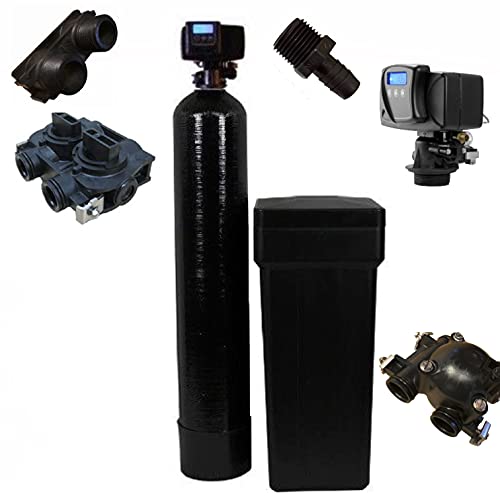
The salt-based benchmark
Fleck 5600SXT 48k
- 48,000 grains
- 12 GPM
- DIY-friendly
- 10-yr warranty
NSF 44 claimedClaimed by manufacturer; not confirmed in NSF public listings
Specs sourced & dated · source
What salt-based owners should expect
Honest expectations cut both ways, so here is the salt-based ownership picture with its chores included. You will haul 40 lb salt bags every four to eight weeks, or pay for delivery. The brine tank needs a glance each time: water level sane, salt not bridged. Regeneration happens at night and discharges to the drain you installed. Once or twice a year, check that hardness at a test tap reads zero; if it creeps, something in the valve or salt system needs attention before the resin takes damage.
For most households none of it is burdensome. But it is work on a schedule, and buying yourself out of that schedule is exactly what a conditioner is selling. Pick the chore load with your eyes open.
Choose salt-free if…
Your goal is specifically scale control with zero maintenance, your municipality restricts brine discharge, or you’re treating a vacation/rental property where salt logistics fail. Just buy it knowing what it is. See our FutureSoft review for what the category can and cannot do.

The salt-free pick
SpringWell FutureSoft FS1
- 12 GPM
- DIY-friendly
- 25-yr warranty
Specs sourced & dated · source
Three households, decided
Scenario 1: family of four, Phoenix municipal water, 14 gpg. Hardness this high means scale is already damaging the water heater and fixtures want constant cleaning. A conditioner would slow new scale but leave every existing symptom partly intact, and soap still underperforms. Sizing gives roughly 39k grains (calculator), which lands in the 40–48k tier. Answer: salt-based, and it isn’t close.
Scenario 2: condo owner, 8 gpg building water, no utility room drain. Softening need is mild, installation constraints are binding, and the HOA may prohibit discharge connections anyway. A compact conditioner installed inline needs no drain and no power. Answer: conditioner, deliberately chosen for what it does rather than marketed promises.
Scenario 3: vacation rental on 22 gpg well water, managed remotely. Salt logistics fail when nobody is on site weekly; an empty brine tank means hard water within days. But 22 gpg also overwhelms conditioners’ scale control. The honest answers are a high-capacity system with property-manager salt service, or portable-exchange service where available. This is the scenario where the right move is a local pro, not a product link.
Where brine discharge is regulated
Some water-stressed jurisdictions limit or ban residential brine discharge, historically around Los Angeles and parts of Southern California, with scattered rules in Texas, Massachusetts, and Michigan. Rules change at the municipal level, so this is a phone call to your water district, not a web search conclusion. Where restrictions apply, the compliant paths are high-efficiency metered valves (some districts approve specific models), portable-exchange services where the dealer regenerates off-site, or conditioning instead of exchange.
Brine rules vary by district even within a metro, so verify locally rather than trusting a regional summary, including this one.
Test first, decide second
Every decision above sharpens with one $15 test strip or one free utility report. What you want to know:
- Hardness in gpg. Under 3.5 gpg, neither category earns its cost for most people; spend the money elsewhere.
- Iron in ppm. Above about 0.3 ppm, factor iron treatment into any softener purchase; above 3 ppm, get a well-water specialist involved.
- Chlorine/chloramine. Irrelevant to softening but decisive for whether you also want carbon filtration.
- Local brine rules, if you lean salt-based.
Our city hardness index has item 1 pulled for most metro utilities. Your utility’s annual water quality report carries items 1 and 3 free, and it is the document we cite when we publish a figure ourselves.
The hybrid reality
Plenty of homes run both problems and both solutions: a softener for the water heater and bathrooms, carbon filtration for drinking/cooking taste. That’s exactly what combo systems package together, pairing ion exchange with a carbon stage in one install. Our whole-house filter guide covers the filtration half; the dedicated combo systems comparison covers pairing them in one install.
Not sure which problem you have? Your utility’s annual report answers it: city hardness index has the number pulled already.