Combos are the highest-ticket purchase in residential water treatment, typically $1,300–2,300 hardware at the value end and well beyond that from dealers, because they solve both of the common problems in one install: hardness and whatever filtration your utility report calls for (usually chlorine or chloramine, sometimes sediment or iron on well water).
The category deserves skepticism first and comparison second, because “combo” describes a bundle, not a component: quality depends entirely on which softener stage and which filter stage got bolted together.
First question: do both problems apply to you?
Run the sequence honestly:
- Hardness: pull your number from the hardness index or your CCR. Under ~7 gpg, most households never notice softening benefits and the softener half of any combo is dead weight.
- Filtration: chlorine smell, cloudy draw-offs, or report flags? Carbon is the usual answer; if nothing in your report or tap suggests a filtration problem, skip that half instead.
- Both confirmed? Then compare three build paths below: a true combo bundle, a paired stack of separate units, and staged pre/post plumbing.
The verified field
| SpringWell CSS1 Combo (CF1 + SS1) | Aquasure Signature Lite AS-SE-LITE650A | Aquasana Rhino Well Water with UV | |
|---|---|---|---|
| Grain cap. | 32,000 | 34,000 | n/a |
| Flow GPM | 9 | n/a | 14.7 |
| Warranty | 25 yr | 5 yr | 10 yr |
| Price | $2,231.25 | $1,299.99 | $1,749 |
| Install | Pro | Pro | Pro |
Amazon prices are live, checked within the last 24 hours; other prices are the manufacturer list price. “See price” means we have no current figure — the product link has it.
DTC flagship pairing
SpringWell CSS1 Combo (CF1 + SS1)
- 32,000 grains
- 9 GPM
- pro install
- 25-yr warranty
NSF 44 claimedClaimed by manufacturer; not confirmed in NSF public listings
Specs sourced & dated · source
SpringWell’s bundle pairs its 32k-grain SS1 softener with the CF1 carbon tank. Read our SS1 review before committing: it is the small SpringWell softener, rated for up to three bathrooms, and priced accordingly. For larger homes SpringWell configures the same pairing on the SS4 platform; check current options at checkout since configurations shift seasonally.
Value bundle
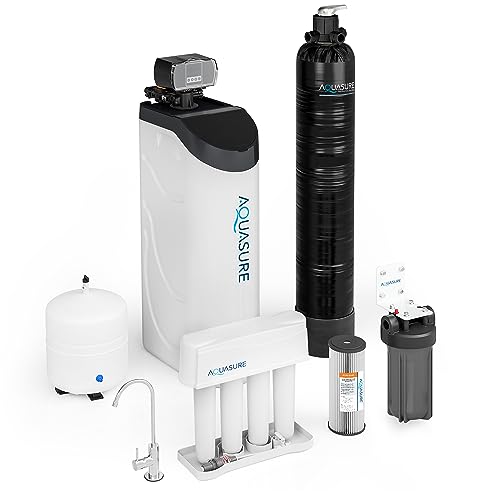
Aquasure Signature Lite AS-SE-LITE650A
- 34,000 grains
- pro install
- 5-yr warranty
NSF 44 claimedClaimed by manufacturer; not confirmed in NSF public listings
Specs sourced & dated · source
Aquasure’s Signature Lite is the budget entry: a 34k-grain softener with a carbon/sediment pairing, frequently discounted below list. Media grades and valve pedigree sit a tier below DTC flagships, which is the honest trade for roughly half their price.
Well-water specialist
Aquasana Rhino Well Water with UV
- 14.7 GPM
- pro install
- 10-yr warranty
NSF 42 claimedClaimed by manufacturer; not confirmed in NSF public listingsNSF 55 claimedClaimed by manufacturer; not confirmed in NSF public listings
Specs sourced & dated · source
The Aquasana Well + UV package is the outlier worth naming: sediment and carbon stages plus ultraviolet disinfection plus a salt-free scaler, aimed at private wells where bacterial screening matters alongside scale control. It is not a softener (conditioning only), so it serves a different buyer than the other two rows; see salt vs. salt-free before choosing this class.
Bundle versus stacked separates
Three honest ways to get both functions:
| Path | Example cost | Pros | Cons |
|---|---|---|---|
| True combo bundle | $1,300–2,300 | One bypass loop, matched flow ratings, single vendor support | Locked media ecosystem; one unit’s failure can idle both halves’ warranty claims |
| Stacked separates | $1,250–1,800 | Pick each stage on merit; generic parts everywhere | Two installs (or one longer job), two vendors if troubleshooting |
| Skipped half | $500–800 | If your report shows no real filtration problem, spending the second half is waste | Requires accepting your utility data over anxiety |
That third row wins more often than retailer merchandising admits. Homes whose report reads clean apart from hardness routinely overspend on carbon capacity they had no use for, and homes with municipal chloramine complaints rarely need forty thousand grains of softener at all. Separate purchases also let service intervals desynchronize: replacing worn softener resin should not drag a healthy carbon tank into a payment decision.
Well-water combos: what changes
Everything above assumes municipal water with a published report. On a private well, three additions enter before any bundle decision:
- A current lab test (hardness, iron, manganese, pH, TDS, nitrate, bacteria). Bundles configured for city water assume none of these; guessing at a $2,000 purchase is how well owners end up with resin fouled orange in a season.
- Sediment pretreatment ahead of everything else. Wells pump grit; every stage behind it lasts longer when a cheap housing eats the particles first.
- Disinfection where the test calls for it, typically UV, which is exactly why the Aquasana well package above exists and why it is priced apart from city-water bundles.
Iron deserves special caution: standard softener resin tolerates roughly 1–3 ppm depending on configuration, and dedicated iron media (air injection or greensand) leads the build above that line. Several of the products in our softener reviews publish iron ceilings in their spec tables; those numbers are load ratings, not decoration.
Questions to settle before any bundle
Whatever the brand, five answers separate good combos from expensive disappointment:
- What are both stages’ flow ratings? The lowest one governs the house.
- What capacity is the softener stage rated at what salt dose? (The reason this matters lives on our capacity explainer.)
- Which certifications does each stage hold, certified versus claimed, on which standards?
- What does year-five ownership cost: salt, cartridges, media swap?
- Whose warranty covers which half, and what voids each?
If a sales page answers none of these plainly, that silence is itself the review.
Installation and footprint
A combo needs roughly two tanks of floor space, power for the control valve, and a drain route sized for regeneration discharge; see the installation checklist which applies identically here. Pairing separate units adds one plumbing hop between them, which any competent installer prices within a normal visit. Flow-rate matching is the spec to check on any bundle: the weakest stage throttles the whole house, so a 15 GPM softener feeding a 7 GPM carbon tank is a 7 GPM home.
Maintenance: two clocks, one closet
Salt refills every four to eight weeks plus carbon media on a multi-year clock; the combo inherits both schedules without merging them. Budget roughly $120–180/year in consumables across both stages at mid-tier hardware, and mark both replacement dates at install.
When a combo is the right call
Both problems confirmed by report and symptom, a utility room with floor space for the pair, and a household wanting one vendor to call. When those all hold, the SpringWell-style DTC bundles deliver good hardware at factory pricing, and Aquasure’s value line undercuts the flagships by hundreds for smaller demand profiles. Everyone else: the best softeners ranking for softening alone, our filter guide for filtration alone, and the calculator before either.