These rankings come from published sizing math rather than commission rates. The inputs are rated grain capacity, service flow rate, regeneration strategy, warranty terms, and certification status, each number sourced and dated per our methodology.
Before any ranking matters, sizing does. A perfectly good 33k-grain unit is the wrong answer for a family of five in Phoenix, and a 64k monster wastes salt in a two-person condo. Start with the sizing calculator or find your city’s hardness in our hardness index, then come back and pick from the tier that fits.
If you are earlier than that, the order is: learn your hardness number, learn what your household draws, then shop. Every softener purchase has to answer three questions, and they are how big, which valve style, and from whom. This page answers the second and third once you have the first; the cost guide prices the whole decision including installation, and salt vs. salt-free rules out half the market in ten minutes if you came here thinking “conditioner” and “softener” were synonyms.
Our top picks
If your home sits on municipal water between 8–20 gpg, the shortlist looks like this:
- Best overall value: Fleck 5600SXT: metered valve, accurately rated capacity, parts everywhere
- Best DTC upgrade: SpringWell SS4: 48k grains at 13 GPM, advertised lifetime warranty, factory-direct
- Best big-box pick: Whirlpool WHES44: properly engineered under $700
- Large homes: Fleck 9100SXT dual-tank: uninterrupted soft water at high demand
- Budget runner-up: Aquasure Harmony 48k: strong capacity-per-dollar
Best overall value: Fleck 5600SXT
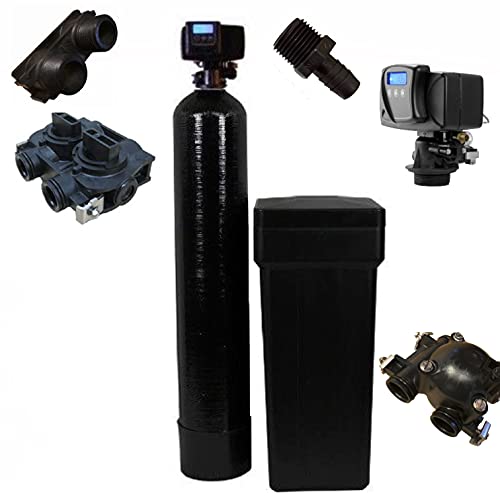
Best overall value · metered
Fleck 5600SXT 48k
- 48,000 grains
- 12 GPM
- DIY-friendly
- 10-yr warranty
NSF 44 claimedClaimed by manufacturer; not confirmed in NSF public listings
Specs sourced & dated · source
The 5600SXT has survived decades because the fundamentals are right: a metered valve that regenerates based on actual usage, resin sized accurately for its rated 48,000 grains, and a parts ecosystem so deep that any plumber can service it blindfolded. Full analysis in our Fleck 5600SXT review.
Its ceiling is real, though: about 12 GPM of service flow. Apartments and most three-bathroom homes sit comfortably inside that; bigger households should look at the SS4 (13 GPM) or the dual-tank option below. Not the SS1: at 11 GPM it is SpringWell’s small size and buys less flow than this Fleck, not more.
Sizing check: family of four at Phoenix-level hardness (14 gpg): 300 gal/day × ~15 gpg compensated ≈ 4,500 grains/day. Over a 7-day regeneration interval plus a 25% safety margin, you land near 39,000 grains, squarely inside this unit’s rated capacity. That math, shown for every pick on this page, is the same one our calculator runs.
Two notes from the ownership side. First, salt efficiency is a setting, not a property of the tank: the same valve can be tuned for maximum capacity (about 15 lb of salt per regeneration) or maximum efficiency (about 6 lb, trading roughly a third of the rated capacity). Metered control makes that tuning worthwhile because the system only regenerates when it has actually used the resin. Second, the 5600 valve platform has been rebuilt rather than replaced for decades, which means a failed motor module, piston or turbine is a $20 to $60 part and a 30-minute fix with a screwdriver. That serviceability is what puts this unit on top of the ranking despite its modest flow.
Best DTC upgrade: SpringWell SS4

Best DTC upgrade · lifetime warranty
SpringWell SS4
- 48,000 grains
- 13 GPM
- DIY-friendly
- 25-yr warranty
NSF 44 claimedClaimed by manufacturer; not confirmed in NSF public listings
Specs sourced & dated · source
SpringWell sells factory-direct, skipping dealer markups that push comparable hardware toward $3–4,000 installed. The SS4 pairs a 48,000-grain bed with 13 GPM of service flow, which SpringWell rates for four to six bathrooms, and advertises a lifetime warranty. Note the size: SpringWell’s entry SS1 is a 32,000-grain, 11 GPM system, so it is the SS4 that belongs in this 48k-class lineup (SS1 review, SpringWell vs. SoftPro).
It is also the priciest pick here, and the SoftPro Elite matches its capacity and flow for $328 less. What you are paying the difference for is warranty length, and we have not yet read SpringWell’s warranty document line by line, so we call the term advertised rather than verified.
SpringWell sizes its line as SS1 (32k grains, 11 GPM), SS4 (48k, 13 GPM), and SS+ for larger homes, so match the tier to your calculator result rather than starting from brand loyalty. The Bluetooth app reports usage and regeneration history, which is diagnostic rather than decorative: a softener that starts regenerating twice as often as it used to is telling you the resin is tiring or something is leaking. Budget-tier valves hold the same information behind a walk to the display.
A detail the marketing pages skip: SpringWell’s NSF compliance is currently a manufacturer claim rather than a public listing we could verify. The chip above says so. It doesn’t disqualify the hardware; it just means the certification point goes to SoftPro until the listing shows up.
Best big-box value: Whirlpool WHES44
Best big-box · under $700
Whirlpool WHES44 44k
- 44,000 grains
- 9 GPM
- DIY-friendly
- 1-yr warranty
NSF 44 claimedClaimed by manufacturer; not confirmed in NSF public listings
Specs sourced & dated · source
Big-box doesn’t mean junk engineering. The WHES44 carries a legitimate 44,000-grain bed, demand-initiated regeneration, and NSF certification claims we’re comfortable with given Whirlpool’s listing history. You give up flow (9.0 GPM rated service, per Whirlpool’s own attribute table), a real parts aftermarket, and warranty depth: one year full coverage versus ten-plus on the Fleck platform. For a two-to-three person home on moderately hard municipal water, those trade-offs can be worth $100+ in savings. Details in the WHES44 review.
Know what the low price buys before you commit. Whirlpool rates service flow at 9.0 GPM, which covers two bathrooms but not a three-bath morning with laundry going. The parts story is proprietary: when something fails out of warranty, you are buying Whirlpool-branded components rather than generic Fleck-platform spares, usually mail-ordered rather than picked up same-day. And the one-year full warranty is the shortest of any pick on this page. For a couple in a moderately hard city who wants a set-and-forget unit from a local store with a return counter, those compromises are rational. Everyone else should spend the extra $40 on the Fleck.
Large homes: Fleck 9100SXT
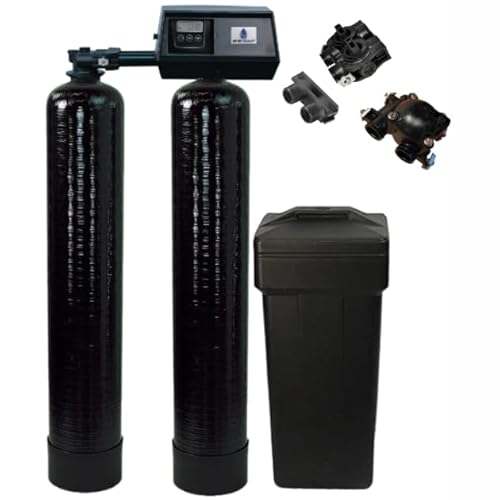
High demand · dual tank
Fleck 9100SXT dual-tank 80k
- 80,000 grains
- 16 GPM
- pro install
- 10-yr warranty
NSF 44 claimedClaimed by manufacturer; not confirmed in NSF public listings
Specs sourced & dated · source
Two tanks alternate: while one regenerates, the other serves. If your household draws 400+ gallons a day, runs multiple showers at 7am, or sits on very hard well water, the 80,000-grain paired bed ends the “hard water breakthrough during regeneration” problem entirely. It’s the most expensive pick here and overkill below ~16 GPM demands; that’s the point where it earns its price.
Mechanically, the tanks alternate rather than run in parallel: the valve draws service water through one bed while the other regenerates, then swaps roles based on remaining capacity. The result behaves like one very large softener that never blinks. Plan the install footprint before ordering, though. Two tanks need roughly double the floor space and a drain route the installer can reach, and the paired system costs meaningfully more to seed with salt on day one.
Budget runner-up: Aquasure Harmony 48k

Runner-up · budget
Aquasure Harmony AS-HS48FM
- 48,000 grains
- 14 GPM
- DIY-friendly
- 5-yr warranty
NSF 44 claimedClaimed by manufacturer; not confirmed in NSF public listings
Specs sourced & dated · source
The Harmony line undercuts even Fleck pricing while shipping a digital metered head and respectable specs. The compromises live in long-term parts availability and a shorter warranty. If budget is the binding constraint, it’s a rational choice. Read the fine print on service support first.
Where Aquasure earns its price is raw specification per dollar: a digital metered head, bypass included, and resin matched to the rated capacity at roughly $12 per 1,000 grains at check time. Where it gives ground is longevity infrastructure: the five-year warranty is mid-pack, and generic replacement parts are less standardized than the Fleck ecosystem. If your plan is to own it for five years and reassess, that trade is fine. If your plan is install-and-forget for fifteen, pay up.
The numbers side by side
Spec data below comes straight from our verified product database; the same rows power every product box on this site.
| Fleck 5600SXT 48k | SpringWell SS4 | Whirlpool WHES44 44k | Fleck 9100SXT dual-tank 80k | Aquasure Harmony AS-HS48FM | |
|---|---|---|---|---|---|
| Grain cap. | 48,000 | 48,000 | 44,000 | 80,000 | 48,000 |
| Flow GPM | 12 | 13 | 9 | 16 | 14 |
| Warranty | 10 yr | 25 yr | 1 yr | 10 yr | 5 yr |
| Price | $825 | $1,785 | see price | $1,669 | $629.99 |
| Install | DIY | DIY | DIY | Pro | DIY |
Amazon prices are live, checked within the last 24 hours; other prices are the manufacturer list price. “See price” means we have no current figure — the product link has it.
How to read it: ★ marks the best value per row across these five (highest capacity, flow, and warranty; lowest list price). List prices are manufacturer figures. Tap any button for today’s merchant price through our click-out, which also keeps this page compliant rather than quoting stale numbers.
Salt: pellets, crystals, or potassium
Salt choice affects running cost more than most hardware decisions. The three common types:
- Pellets (evaporated): the default recommendation. Cleanest burn, least bridging, widest availability. Roughly $7–10 per 40 lb at big-box prices.
- Crystals (rock/solar): a dollar or two cheaper per bag in some regions, slightly more prone to bridging and sediment in the brine tank. Fine for tanks you check regularly.
- Potassium chloride: functions identically in the exchange but costs two to three times as much per pound, chosen mainly by households managing sodium intake who do not want a separate unsoftened tap.
Whichever you choose, buy one type and stay with it; mixing is how bridges form. Store the bags dry, too: salt that clumps in the garage is salt that bridges in the tank.
One efficiency note that pays for itself: most metered valves expose a salt-dose setting, and dropping from the factory default toward the efficient end typically saves $20–50 of salt per year on a family-sized system while costing one extra regeneration every few weeks. Our sizing margin absorbs it.
Why capacity numbers move around
A rated grain capacity is not a physical constant; it is a performance point chosen by the manufacturer at a specific salt dose. The same cubic foot of resin might be sold as 30,000 grains at a 4 lb salt setting, 40,000 at 9 lb, or 48,000 at 15 lb. Higher salt doses squeeze more capacity from each regeneration but waste salt doing it, which is why “high-efficiency” marketing usually means the same resin run leaner.
The practical takeaway for comparing systems: only compare capacities at stated salt doses, and treat any spec sheet that omits the dose as marketing first and documentation second. Our database records the rated figure each manufacturer publishes and flags the dose where they state it. When you size with our calculator, the 25% margin exists partly to absorb exactly this ambiguity.
| Setting on a 1.5 cu ft bed | Salt per regen | Rated capacity | Regens/month (family of 4, 14 gpg) |
|---|---|---|---|
| Efficiency-minded | ~6 lb | ~32,000 gr | ~4–5 |
| Balanced | ~10 lb | ~42,000 gr | ~3 |
| Capacity-maxed | ~15 lb | ~48,000 gr | ~3 |
Same tank, three ratings. On a metered valve that is a menu setting, not a second purchase.
The rest of the verified field
Beyond the five picks, these systems are in our database with checked specs and earn a place in the comparison for specific situations:
| GE GXSH45V 45k | Rheem Preferred Plus RHS42 | Whirlpool WHES33 33k | Aquasure Harmony AS-HS32FM | Aquasure Harmony AS-HS64FM | |
|---|---|---|---|---|---|
| Grain cap. | 45,100 | 42,400 | 33,000 | 32,000 | 64,000 |
| Flow GPM | 12 | 9.9 | 8 | 11 | 16 |
| Warranty | 1 yr | 1 yr | 1 yr | 5 yr | 5 yr |
| Price | see price | see price | see price | $523.29 | $749.99 |
| Install | DIY | DIY | DIY | DIY | Pro |
Amazon prices are live, checked within the last 24 hours; other prices are the manufacturer list price. “See price” means we have no current figure — the product link has it.
The GE GXSH45V is the Whirlpool WHES44’s closest rival: 45,100 grains against 44,000, and 12 GPM against 9.0, for $50 more. Between those two, buy whichever is cheaper at your local store that week. Rheem’s PREFERRED Plus sits in the same class at 42,400 grains and 9.9 GPM, though its price is the one figure on this page we have not been able to check against a manufacturer page. The WHES33 and Harmony 32k serve one-to-two-person homes whose calculator results land under 30k grains, and the Harmony 64k covers the gap between single-tank budget units and dual-tank money.
What installation actually involves
Every tank-style softener on this page needs the same four connections: inlet, outlet, drain, and (except conditioners) a brine-tank overflow line. If your main line already has a bypass loop with stub-outs, a handy homeowner finishes in an afternoon; most 5600SXT owners report two to four hours including the brine line. If the plumber must cut into copper, sweat fittings, or add a loop from scratch, that is the $150–500 job described on our cost page.
Three pre-buy checks save callbacks: confirm a working electrical outlet within reach of the valve (conditioners aside, valves need power); confirm a drain route with fall to it, since regeneration discharges 50-ish gallons per cycle; and check local code on discharge routing, because some municipalities want an air gap into the standpipe rather than a direct tie-in.
Where certification stands on every pick
As of our last check against info.nsf.org, none of the five picks carried a certification listing we could pin and link; every chip above reads claimed. That is not an accusation. Residential listings update slowly, and brands often certify specific configurations only. We maintain the claimed-versus-certified chips precisely so this page updates mechanically when listings land, and our methodology explains what would move any product from one state to the other.
How we chose these five
Our ranking weights, in order: matched capacity per dollar (rated grains ÷ list price), metered/on-demand regeneration (calendar-only valves waste salt and water), service flow rate against realistic household demand, warranty structure, and finally certification status: certified listings beat claims, and we mark the difference on every chip.
We excluded, deliberately: salt-free “softeners” as primary recommendations (they condition scale; they don’t remove hardness; see salt vs. salt-free, and if you need filtration alongside softening rather than instead of it, see combo systems); dealer-installed national brands whose quotes bundle monitoring contracts into $3,000+ invoices (we cover that economics in brand comparisons); and any product whose specification sheet contradicts its marketing page. If we can’t source a number, it doesn’t appear here.
Affiliate commissions exist on some links above; they never touch this order. The ranking was computed from the spec table before commercial terms entered the room, and the methodology explains exactly how that separation works.
A word on how the weights behave at the edges. At tiny volumes (one or two people), capacity per dollar stops mattering because every unit is oversized; warranty and parts availability dominate, which is why a budget Fleck still beats cheaper no-name imports. At very high hardness (25 gpg plus), flow rate and iron tolerance dominate everything else, which pushes toward dual-tank or pretreatment setups rather than any single-tank pick here. And in brine-restricted municipalities, the entire salt-based field is moot until you have checked local rules; conditioners become the fallback by regulation rather than preference.
Big-box vs. pro-grade vs. DTC: what each tier sells
The three price tiers on this page exist because each one bundles a different promise. Big-box units (Whirlpool, GE, Rheem) sell retail convenience: local stock, a return counter, and a familiar brand on the box, at the cost of flow rate and proprietary parts. Budget pro-grade units (Fleck platform, Aquasure) sell serviceability: generic parts, plumber-familiar valves, and honest capacity at the lowest price-per-grain in the market. DTC units (SpringWell SS4, SoftPro Elite) sell warranty depth and support: factory-direct staff who answer the phone, longer coverage terms, and enough margin to fund both.
None of those promises is dishonest. The mistake buyers make is paying for benefits they will never use. A retiree who wants a local number to call is well served by big-box. A hands-on owner with a drain loop already stubbed in is overspending anywhere above budget pro-grade. A six-bathroom household needs DTC flow headroom or dual-tank hardware, and no amount of thrift changes that.
Match the purchase to the promise you actually want:
| If this sounds like you | Start here |
|---|---|
| “I want it from a store I can drive to” | WHES44 or GXSH45V |
| “I don’t mind a weekend install and cheap parts” | Fleck 5600SXT |
| “I want the longest coverage and phone support” | SpringWell SS4 / SoftPro Elite |
| “My calculator result exceeds 60k grains” | Fleck 9100SXT |
What we verified, and what we did not
Every specification on this page was pulled from manufacturer documentation and recorded in our database with a source URL and check date. Prices are the list figures published at check time; live merchant pricing arrives through the buttons. Where a brand’s spec sheet disagreed with its marketing page, we recorded the discrepancy in our notes and, where relevant, said so in the review.
What we have not done yet is pin NSF listing numbers for every claim. The certification chips above therefore read claimed across the board until that pass completes, including for brands whose history suggests real listings exist. We would rather understate certification today and correct upward than the reverse. The same standard applies to SpringWell’s lifetime warranty: advertised, not yet line-by-line verified.
If you buy through links on this page and later find a spec wrong, the corrections address is on our methodology page and we fix errors rather than quietly editing them.
Water heater math: why softening pays for itself
The strongest financial argument for softening is not the dishes; it is the water heater. Scale acts as insulation between the burner or element and the water, so a scaled heater burns more fuel for the same hot water and its elements fail sooner. Softened water keeps that heat-transfer surface clean.
The industry publishes efficiency-loss percentages for this, and we are not going to quote one until we have read the underlying study, because the ones in circulation are industry-funded and quoted third-hand. The mechanism itself is not in dispute, and on 15+ gpg water the heater argument alone often covers the operating costs on our cost page within a few years.
Hardness, iron, and what a softener will not fix
A softener solves hardness, and incidentally clears low levels of dissolved iron. It does not solve sediment, chlorine, lead, bacteria, or PFAS, and buying one expecting those problems to leave is the most common mismatched purchase in this category.
Quick triage before you buy:
- Hard water signs only (scale, spotting, soap scum): softener alone.
- Rust staining on fixtures and laundry: dissolved iron; most tanks above handle 1–3 ppm with proper settings, but confirm your level.
- Rotten-egg smell: hydrogen sulfide, needs dedicated media, not resin.
- Chlorine taste or odor: carbon filtration; see our filter guide.
- Private well with any of the above plus bacteria concerns: test first, treat second. No tank on this page is a substitute for a lab test.
If two problems coexist, sequencing matters: iron and sediment belong ahead of the softener so the resin does not foul early.
What actually breaks, in order
Softeners fail in boring, fixable ways long before resin dies. In rough order of what actually breaks:
- Bridging in the brine tank. Salt fuses into a shelf above the water line; the system regenerates with plain water and hardness creeps back. Fix: break the bridge with a broom handle, $0.
- Clogged injector or screen. Sediment fouls the venturi that draws brine. Fix: clean or replace the injector assembly, $10–30.
- Motor module or piston wear. Valve stops cycling reliably. On a 5600 platform this is a $20–60 part; on proprietary heads it means a factory part order.
- Resin exhaustion or fouling. Ten-plus years in, or early on high-iron wells without pretreatment. Fix: resin replacement, $200–400 in media plus labor.
Every pick above except the Whirlpool can be serviced from generic parts catalogs, and that difference compounds over a decade of ownership.
The sizing math behind every pick
Every recommendation on this page passes the same published formula:
daily demand      = people × 75 gal/day
compensated GPG   = hardness GPG + (iron PPM × 4)
weekly load       = daily demand × compensated GPG × 7 days
required capacity = weekly load × 1.25 safety margin
Worked example: family of four, 14 gpg city water, minimal iron. 300 gal/day × 15 gpg = 4,500 grains/day → × 7 days = 31,500 → × 1.25 ≈ 39,400 grains, which lands you in the 40–48k tier all three mid-size picks occupy. A couple on 18 gpg well water with 1 ppm iron needs 150 × 22 = 3,300/day → 28,900 after margin, the WHES44’s neighborhood.
Run your own household through the calculator, which uses identical constants, cited on the page. And if you know your utility, our city hardness index has already pulled the number from your water department’s annual report.
Past the buying decision, the questions change from which unit to how it behaves: how to size one in detail, how often it should regenerate, what installation involves, and how long it should last. The full set is in our support guides.