Both run the same valve family and the same metered philosophy, so the choice comes down to your household’s demand profile. The 5600SXT is the industry’s value benchmark; the 9100SXT exists for homes that break single-tank sizing math.
Why this valve family dominates
Fleck is Pentair’s residential valve line, and the 5600 platform has been in production long enough that most working plumbers trained on it. That history built a parts and knowledge ecosystem nobody else in the category matches: generic rebuild kits sit on the shelf at plumbing suppliers nationwide, YouTube covers every failure mode, and any independent installer can service the valve without a factory call.
Both units here ride that ecosystem. The SXT suffix denotes the digital control head with metered, demand-initiated regeneration; the tanks, resin, and brine hardware around the valve are assembled by whichever seller packages the system, which is why identical Fleck heads appear under many storefront names. Buy on the complete package’s specs and support, not the head alone.
The numbers
| Fleck 5600SXT 48k | Fleck 9100SXT dual-tank 80k | |
|---|---|---|
| Grain cap. | 48,000 | 80,000 |
| Flow GPM | 12 | 16 |
| Warranty | 10 yr | 10 yr |
| Price | $825 | $1,669 |
| Install | DIY | Pro |
Amazon prices are live, checked within the last 24 hours; other prices are the manufacturer list price. “See price” means we have no current figure — the product link has it.
How metered regeneration works
A metered valve measures water as it passes through and counts down the resin’s remaining capacity between regenerations. When usage has consumed the bed, the valve schedules a cycle for the low-usage hours. Calendar- timer valves instead regenerate on schedule whether or not the resin was spent: waste when you under-use it, hardness breakthrough when you over-use it.
Metering is why both Flecks can safely run aggressive capacity ratings. The valve knows what the resin actually delivered rather than guessing from the calendar. It also enables the salt-dose tuning described across our reviews, and it makes vacation behavior sensible: no usage means no regeneration.
One setting worth checking after install regardless of model: reserve capacity. Metered systems hold back a portion of rated capacity so an unexpected heavy day does not break through before the scheduled regeneration. Defaults are conservative; our sizing margin already accounts for them.
What “dual tank” actually buys you
A single-tank softener must go offline to regenerate, typically 60–90 minutes of hard-water passthrough, usually scheduled for 2am when nobody showers. The 9100SXT’s two tanks alternate: one regenerates while the other serves. That eliminates breakthrough and lets an 80k paired bed keep up with sustained heavy draws.
Three scenarios where that matters:
- High sustained demand: households of 5–6+ on hard water whose calculator result exceeds ~55–60k grains.
- Very hard wells: 20+ gpg with iron, where regeneration frequency would otherwise interrupt service daily.
- No-offpeak households: shift workers, home daycare, anyone drawing significant water around the clock.
What the second tank costs you
The 9100SXT alternates rather than running both beds in parallel: the master valve tracks remaining capacity across the pair and routes service flow through whichever tank is charged. The household never sees a soft-water gap. What you own in exchange is two pressure vessels, twice the resin to replace eventually, and a valve assembly with more logic in it.
Two consequences are worth weighing before ordering:
- Footprint and plumbing. Two tanks need floor space and a drain route sized for either bed’s regeneration, plus clearance for future media replacement on both.
- Failure surface. More hardware means more potential failure points, though each one remains cheap generic-platform hardware. Alternating Fleck installations have a good reliability record because the underlying parts are commodity items.
Where the 5600SXT still wins outright
Below ~45k grains of calculated need and ~12 GPM demand, the second tank is dead weight. The 5600SXT delivers identical water quality, halves your outlay, and keeps the cheapest parts ecosystem in the business.
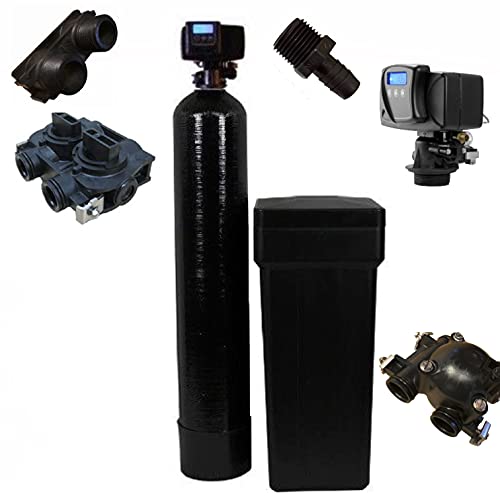
The default pick
Fleck 5600SXT 48k
- 48,000 grains
- 12 GPM
- DIY-friendly
- 10-yr warranty
NSF 44 claimedClaimed by manufacturer; not confirmed in NSF public listings
Specs sourced & dated · source
Full analysis in the 5600SXT review.
Five households, sized
Each example runs our published formula at 14 gpg municipal hardness unless noted:
| Household | Calculated need | Right choice | Why |
|---|---|---|---|
| Retired couple, city water | ~26k grains | 5600SXT (oversized on purpose) | Efficiency setting shrinks effective bed; parts culture wins |
| Family of 4, 2.5 baths | ~39k grains | 5600SXT | Squarely inside its envelope |
| Family of 4 + frequent guests, well at 20 gpg w/ 1 ppm iron | ~66k grains | 9100SXT | Single-tank math broken; iron shortens regen intervals further |
| Home daycare, 6+ residents, all-day draws | ~60k grains | 9100SXT | No quiet hours for regeneration windows |
| Small B&B, 8 rooms | 80k+ effective | 9100SXT, possibly staged pairs | Continuous service is the business |
Dual-tank earns its price when demand is large and unforgiving of a midnight service gap. A large household with quiet hours can let the single tank do its work overnight.
Cost math
| System | Rated capacity | Price | Per 1,000 grains |
|---|---|---|---|
| Fleck 5600SXT 48k | 48,000 | $825 | $17.19 |
| Fleck 9100SXT dual-tank 80k | 80,000 | $1,669 | $20.86 |
Cheapest capacity first. Amazon prices are live, checked within the last 24 hours; other prices are the manufacturer list price.
On running cost the 5600SXT is the baseline; the 9100SXT costs slightly more per regeneration but runs fewer of them, because alternating beds regenerate a single tank at a time against measured demand.
The dual-tank premium shows up in that last column, but it is a premium of tens of percent, not multiples — the gap between these two is far smaller than the gap between either of them and the boutique tier. So this decision isn’t really about efficiency. It’s about whether continuous-service capacity is a real requirement in your house.
Salt and water costs scale with regeneration count rather than tank count, so the dual system’s slightly higher per-cycle use is offset by fewer cycles at matched household demand; ten-year consumable spending lands within roughly $50 of each other in most scenarios. The real cost difference is hardware, freight weight on delivery day, and eventual media replacement priced for two beds.
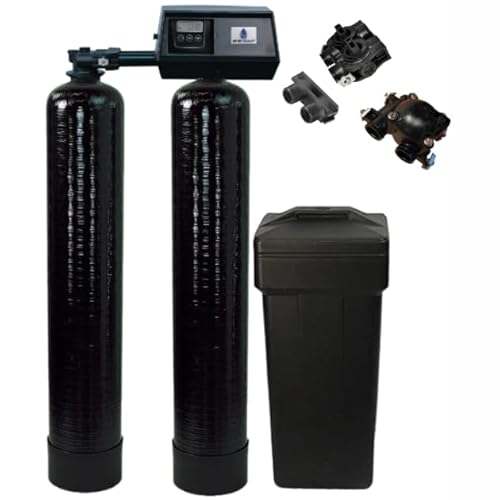
For high-demand homes
Fleck 9100SXT dual-tank 80k
- 80,000 grains
- 16 GPM
- pro install
- 10-yr warranty
NSF 44 claimedClaimed by manufacturer; not confirmed in NSF public listings
Specs sourced & dated · source
Installation and ownership notes
Both units ship as complete systems with bypass valves, and both follow the same install pattern described on our cost page: four connections (inlet, outlet, drain, overflow) plus power. The 5600SXT is the classic first-DIY-install softener precisely because its manual is clear and every connection is standard. The 9100SXT adds a second tank set and interconnect plumbing; it remains a DIY job for someone comfortable with the single-tank version, but freight weight crosses 200 lb total and two vessels down a basement stairwell needs a second pair of hands.
Ownership differences after install are small: identical salt routine, identical test-and-verify habit, and one extra tank to glance at during annual brine checks. Noise during regeneration (a brief rush at the drain) is comparable.
Verdict
Our verdict
Default to the 5600SXT unless your sizing result exceeds its envelope or round-the-clock demand makes regeneration windows a problem. The 9100SXT isn’t a luxury upgrade; it’s a different tool for demand profiles the single tank can’t serve. Size first: calculator, then decide.